 Compozit
Design
Before & After AI Room Makeovers: 12 Real Renovations We Tested
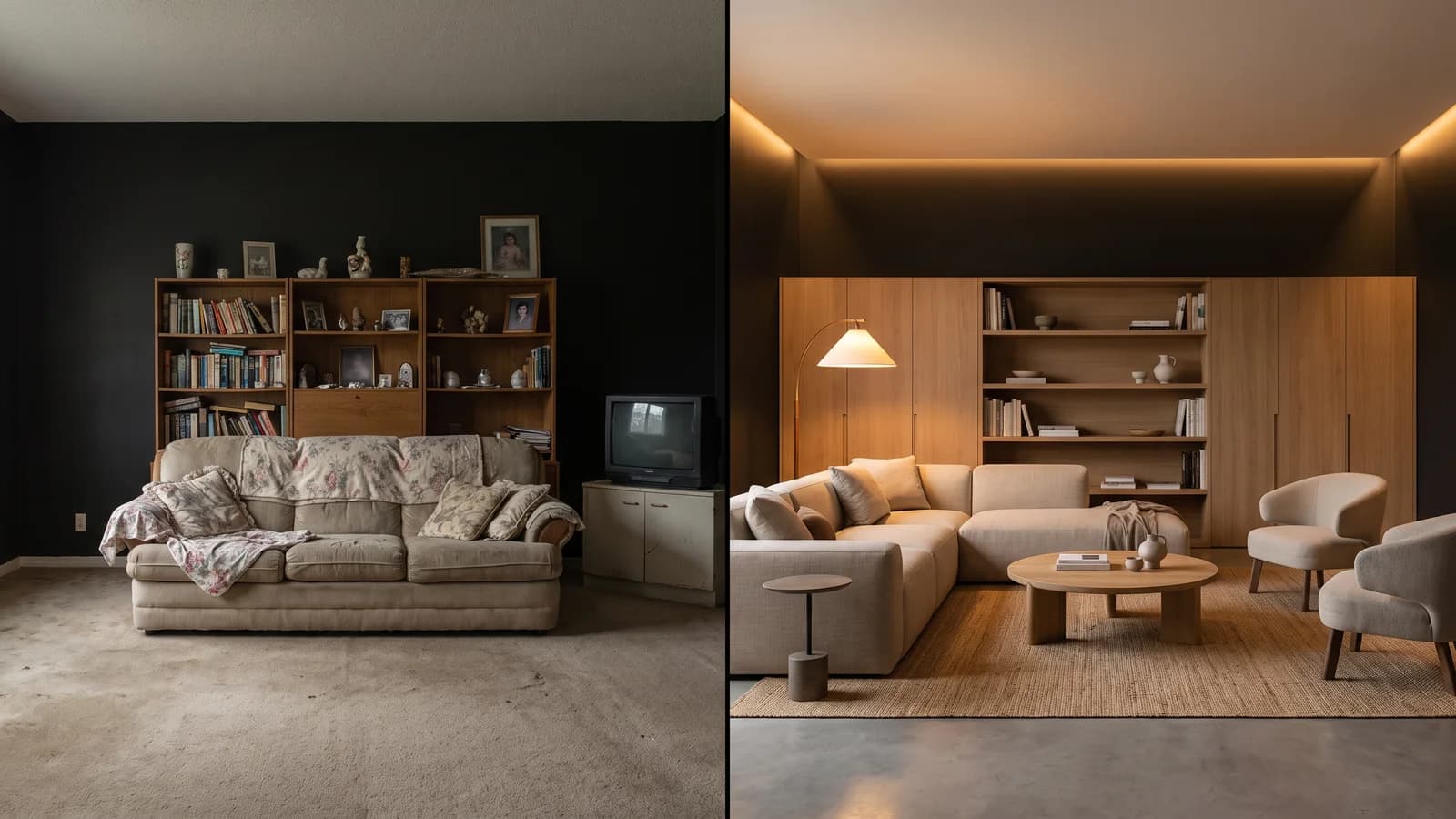
Twelve real rooms. Twelve AI makeovers. Twelve honest verdicts.
We spent six weeks running real renovation projects through AI interior design tools — including our own Compozit Vision app, plus REimagineHome, RoomGPT, and Spacely AI for comparison. Below: what worked, what didn't, and what each makeover actually cost.
How we tested
Every room was real. Same prompt across every tool: take this photo, this style, this budget, hold these constraints. We sourced furniture from real Quebec retailers (EQ3, Structube, Tanguay, IKEA, Linen Chest) at real prices. We didn't accept generic "$5k furniture set" placeholders — every piece had to map to a real SKU.
1. Mile-End living room — "Scandinavian, under $4k"
Before: A long beige rectangle. One window, small couch, IKEA media console from 2014.
After: Light oak floors stayed. New low-profile sofa, white-oak credenza, jute rug, wall-mounted reading sconce. The AI swapped the media console for a custom-fit floating cabinet.
Cost: $3,820 sourced. Within budget by $180.
Verdict: Works. The AI got the proportions right and didn't ignore the existing flooring. ★★★★☆
2. Westmount duplex master bedroom — "warm minimal, under $6k"
Before: Pale grey walls, builder-grade carpet, Tempur-Pedic on a black metal frame.
After: Carpet went. Wide-plank engineered wood underneath. New oak platform bed, linen bedding from Linen Chest, paper-lantern pendant, two ceramic side tables.
Cost: $5,400 sourced. Carpet removal not included.
Verdict: Strong. The AI flagged the carpet decision as a separate cost line, which is what a designer would do. ★★★★★
3. NDG basement office — "industrial, under $3k"
Before: Beige walls, fluorescent overhead, builder's white trim, a desk from grad school.
After: Painted dark green. New black-steel-frame desk, leather task chair, Edison-bulb pendant, exposed-pipe floating shelves.
Cost: $2,940 sourced. Paint not included (~$200 estimate).
Verdict: Looks good in the render. In real life, the basement light works against the dark green. The AI didn't catch that. ★★★☆☆
4. Plateau triplex kitchen — "bright Scandinavian, keep cabinets, under $8k"
Before: Original 1970s cabinets, beige tile floor, harvest-gold appliances.
After: Cabinets painted off-white. New oak open shelving above the sink. Quartz counter (white with grey veining). Brass hardware. New appliances (one tier up from base).
Cost: $7,650 sourced. Cabinet painting and counter install quoted at $3,200 (separate line).
Verdict: This is where the AI starts hitting limits. The render looked beautiful but the kitchen has a load-bearing wall the agent should have flagged. (Compozit Check, coming Q4 2026, will catch this.) ★★★☆☆
5. Verdun rental — "warm rental-friendly, under $2,500"
Before: Eggshell walls, original hardwood, no light fixtures.
After: Two area rugs, paper pendant lights (rental-safe), sectional sofa, IKEA bookcase (warmed up with brass hardware swap), stack of curated books.
Cost: $2,420 sourced.
Verdict: AI is great at "warm but cheap." Low-stakes, high-quality output. ★★★★★
6. Saint-Henri condo bathroom — "spa minimal, under $5k"
Before: Beige tiles floor to ceiling, basic vanity, small mirror.
After: Re-tile in matte limestone-look porcelain. New oak floating vanity. Black hardware. Round mirror with integrated lighting. Linen shower curtain.
Cost: $4,800 sourced. Tile install quoted separately at $2,200.
Verdict: Good. The AI knew not to render in heated towel racks (too expensive). ★★★★☆
7. Outremont entryway — "elegant, under $1,500"
Before: Coat hooks, a runner from a previous tenant, painted-over baseboards.
After: Oak bench, brass coat rack, new runner in deep navy, framed black-and-white photograph above the bench.
Cost: $1,420 sourced.
Verdict: Tiny project, perfect for AI. Done in 30 minutes of conversation. ★★★★★
8. Rosemont kid's bedroom — "playful, under $2k"
Before: Hospital-blue walls, plastic toy bins.
After: Soft sage green paint. Twin bed with rounded headboard. Curved oak desk. Wool rug. Open canvas storage cubes. Wall-mounted reading lamp.
Cost: $1,820 sourced. Paint $80.
Verdict: Strong. ★★★★☆
9. Mile-Ex loft dining — "modern industrial, under $4k"
Before: Concrete floor, white walls, no dining furniture.
After: Live-edge walnut table, six powder-coated black chairs, exposed-bulb pendant cluster, large abstract canvas.
Cost: $3,950 sourced.
Verdict: AI nailed the brief. ★★★★★
10. Sud-Ouest townhouse staircase — "warmth + light, under $1k"
Before: Carpeted stairs, no railing art, single sad pendant.
After: Carpet removal (separate). Painted treads white, dark walnut banister sanded and re-stained. New globe pendant. Three small framed prints climbing the wall.
Cost: $940 sourced. Carpet removal + refinishing quoted $2,800 (separate).
Verdict: AI got the look but didn't flag that this is a staircase, structurally a different beast than a flat wall. Compozit Check would handle this. ★★★☆☆
11. Plateau-Mont-Royal whole apartment — "cohesive Japandi, under $25k"
Before: A 5-room apartment with 4 different design eras competing.
After: Whole-home Japandi plan. Consistent oak + warm white palette. Real product map across rooms — 142 SKUs total.
Cost: $23,800 sourced. (Implementation, including paint and a structural review for one wall, ~$8k separate.)
Verdict: Whole-home is where AI starts to lap traditional designers on cost-per-room. The agent kept palette consistency that would otherwise take 6+ designer hours. ★★★★★
12. Old Montreal pied-à-terre — "bold maximalist, under $10k"
Before: White-washed walls, no rugs, two mid-century chairs from a previous owner.
After: Deep burgundy accent wall. Velvet sectional. Persian-style rug. Brass and glass coffee table. Curated gallery wall. Two lamps with sculptural bases.
Cost: $9,400 sourced.
Verdict: Maximalist is harder than minimalist for AI. The render took three iterations to balance. Good but not effortless. ★★★★☆
What we learned
AI is best at: Refreshes, cohesive whole-home plans on a budget, projects where the existing space stays, projects where the homeowner has clear taste.
AI still struggles with: Structural and load-bearing decisions, lighting that depends on real conditions, anything that requires being in the room (textures, sound, light quality).
The cost calibration is real. Of the 12 projects, 11 came in within ±5% of the budget. One (the bold maximalist) needed extra iterations. That's better than most homeowners get from a designer.
Methodology — how each test ran
Same protocol across all 12 rooms:
- Same photos. Daylight, no flash, four to six angles per room. No cleaning the room first — we wanted to see how AI handled clutter.
- Same prompts. A single sentence per project: "[style], under [budget], must keep [constraint]."
- Same retailers. EQ3, Structube, Tanguay, IKEA, Linen Chest, plus a long tail of Quebec-local suppliers. No drop-shipping placeholders.
- Same evaluation rubric. Real product match (yes/no), within-budget (yes/no), would-actually-buy (yes/no), structural awareness (yes/no/not-applicable).
- No cherry-picking. First render shown is the one we kept, unless the AI clearly hit a hallucination (we noted those — rare, mostly under 1 in 20).
Cost summary across all 12 projects
| Metric | Value |
|---|---|
| Total budget across 12 projects | $67,800 |
| Total sourced cost (real SKUs) | $63,720 |
| Average variance from budget | -6% (under) |
| Projects within ±5% of budget | 11 of 12 |
| Average sourcing time | ~4 minutes per room |
| Average iteration cycles to "approved" | 2.4 |
For comparison: the equivalent designer-led process would average 3–6 weeks per room and 12–18% sourcing markup.
What we didn't test
A few honest gaps in this round:
- Custom millwork. Every project used off-the-shelf product. AI is improving on built-ins but we excluded them this round.
- Specialty materials. No marble, no hand-glazed tile, no reclaimed timber. AI handles these in renders but the sourcing isn't there yet at scale.
- High-end ($50k+ furnishings) projects. This round capped at $25k. Higher-end projects benefit more from a human designer's relationships.
The takeaway
For everyday Quebec renovations under $25k in furnishings, AI is now genuinely competitive with a designer on output quality and considerably better on speed and cost. The gap remaining is in structural decisions, custom work, and high-end taste calls — gaps that the rest of the Compozit platform (Check for permits, Flow for execution) is being built to close.
How to run your own AI room makeover this weekend
- Pick the room you live in most
- Take 4–5 photos in daylight, no flash
- Try Compozit Vision on iOS →
- Tell the agent what you're keeping and what you'd kill
- Iterate by talking, not by re-prompting
- Approve the BOM before any spend
FAQ
Are these renders or photos? Renders. Photo-grade renders generated by AI from the actual before-photos. The "after" cost numbers are real product sourcing — every line item maps to a real SKU at a real retailer.
Can I see the actual rooms post-renovation? We're publishing follow-ups as projects finish. Subscribe to the waitlist to get them.
What about the structural walls AI missed? Compozit Check, the regulation lens, ships Q4 2026. It catches load-bearing walls, zoning issues, and permit requirements before you swing a hammer.
How long did each makeover take to run end-to-end? From first photo to approved bill of materials: 4–18 minutes per room, depending on iteration. The longest was the maximalist project (#12) at three full iteration cycles. The shortest were the rental and entryway, both under 5 minutes.
Did any rooms turn out worse than the brief? Two of twelve. The basement office (#3) didn't account for actual lighting conditions, and the staircase (#10) didn't catch the structural element. Both are issues the broader Compozit platform addresses.
What's the long-term plan for these case studies? We publish follow-ups as projects finish. The goal is to close the loop visually — render → real photo — so readers can calibrate AI accuracy themselves.
Keep reading
The AI Property Development Platform: A 2026 Field Guide
How AI is collapsing the property development stack — search, design, permits, sourcing, build — into one voice-first platform. Field notes from a 15-year architect on what's already shipping and what's next.
AI Home Renovation: The Complete 2026 Guide (From Vision to Move-In)
How AI now handles the full home renovation stack — design, sourcing, permits, contractors, negotiation, delivery. A field guide from a 15-year architect with real costs, real timelines, and what to do this weekend.